

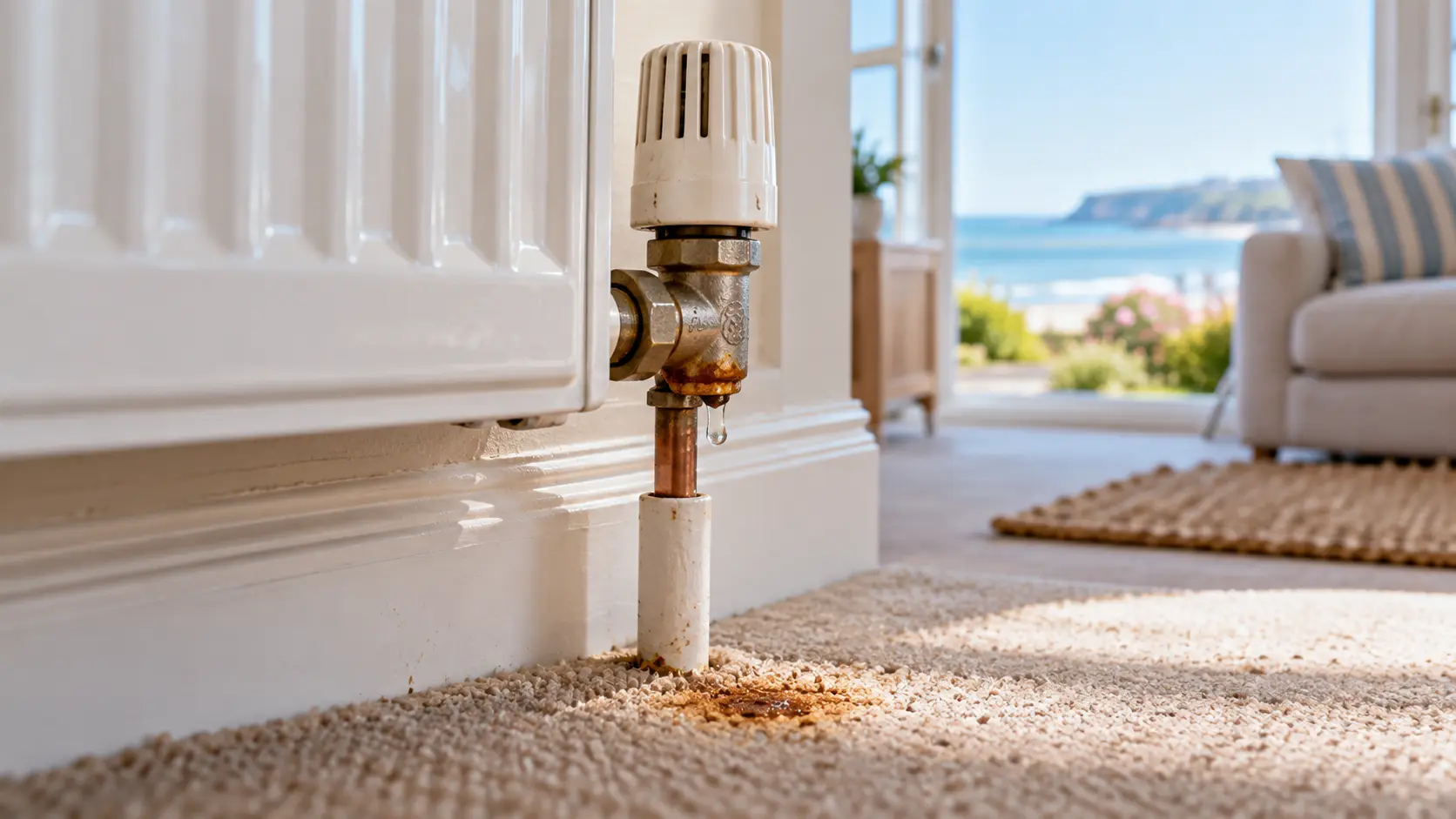
Your boiler is losing pressure because water is escaping from the sealed heating system, or a component isn’t holding pressure as it should. The usual causes are a small leak on a radiator valve or pipe joint, air let out when bleeding radiators, a pressure relief valve that’s letting water past, or an expansion vessel that has lost its charge.
Most combi and system boilers should read about 1 to 1.5 bar when the heating is off and cool. Occasional top-ups are normal. Regular ones mean it’s time for a boiler repair.
Clues that point to the cause
| What you notice | Likely cause |
| Dropped after bleeding radiators | Air released; top up and monitor |
| Slow, steady drop | Small leak in pipework or radiators |
| Outside pipe dripping | Pressure relief valve |
| Big rise when heating is on | Expansion vessel |
| Water under the boiler | Internal leak |
Leaks to look for
- Around radiator valves and tails
- On pipe joints under sinks and in cupboards
- Stains on ceilings beneath radiators or bathrooms
- Rust or damp at the bottom of radiators
The relief valve and expansion vessel
The pressure relief valve lets water out if pressure gets too high. If the expansion vessel has lost its charge, pressure rises sharply when water heats, which can push water out through the relief valve. Fixing the vessel often cures both problems. Both are engineer jobs.
Topping up safely
- Turn the heating off and let it cool
- Find the filling loop or key (your manual shows where)
- Open slowly and watch the gauge
- Close at the recommended pressure
- Reset the boiler if it locked out
Don’t open the boiler casing.
Why not just keep topping up?
- Leaks can damage floors, ceilings and walls
- Fresh water brings in oxygen, which speeds up corrosion
- Corrosion creates sludge, which can damage the boiler and radiators
Bognor Regis homes
Around Bognor Regis, Felpham, Aldwick and Rose Green, many bungalows and older homes have had combis fitted onto pipework originally used for an open-vented system. Older joints can start to weep under sealed-system pressure. If your pressure problems started after a boiler change, it’s worth having the system checked.
Flow temperature settings can also affect how hard the system works. Our guide on what boiler flow temperature to use explains more.
Frequently asked questions
How often should I need to top up my boiler?
Rarely. Once or twice a year at most, usually after bleeding radiators. More often means there’s a fault.
Is it safe to use the boiler with low pressure?
Most boilers lock out when pressure is too low. Top it up and, if it keeps dropping, get it checked.
Can a boiler service find the cause?
Often, yes. The engineer checks the expansion vessel and relief valve as part of the service. See our boiler installation page if a replacement turns out to be the better option.
Get pressure problems sorted
If your boiler keeps losing pressure, give me a call on 07545 916929 or drop me a message and I’ll get it sorted for you.